Classic Homemade Bagels
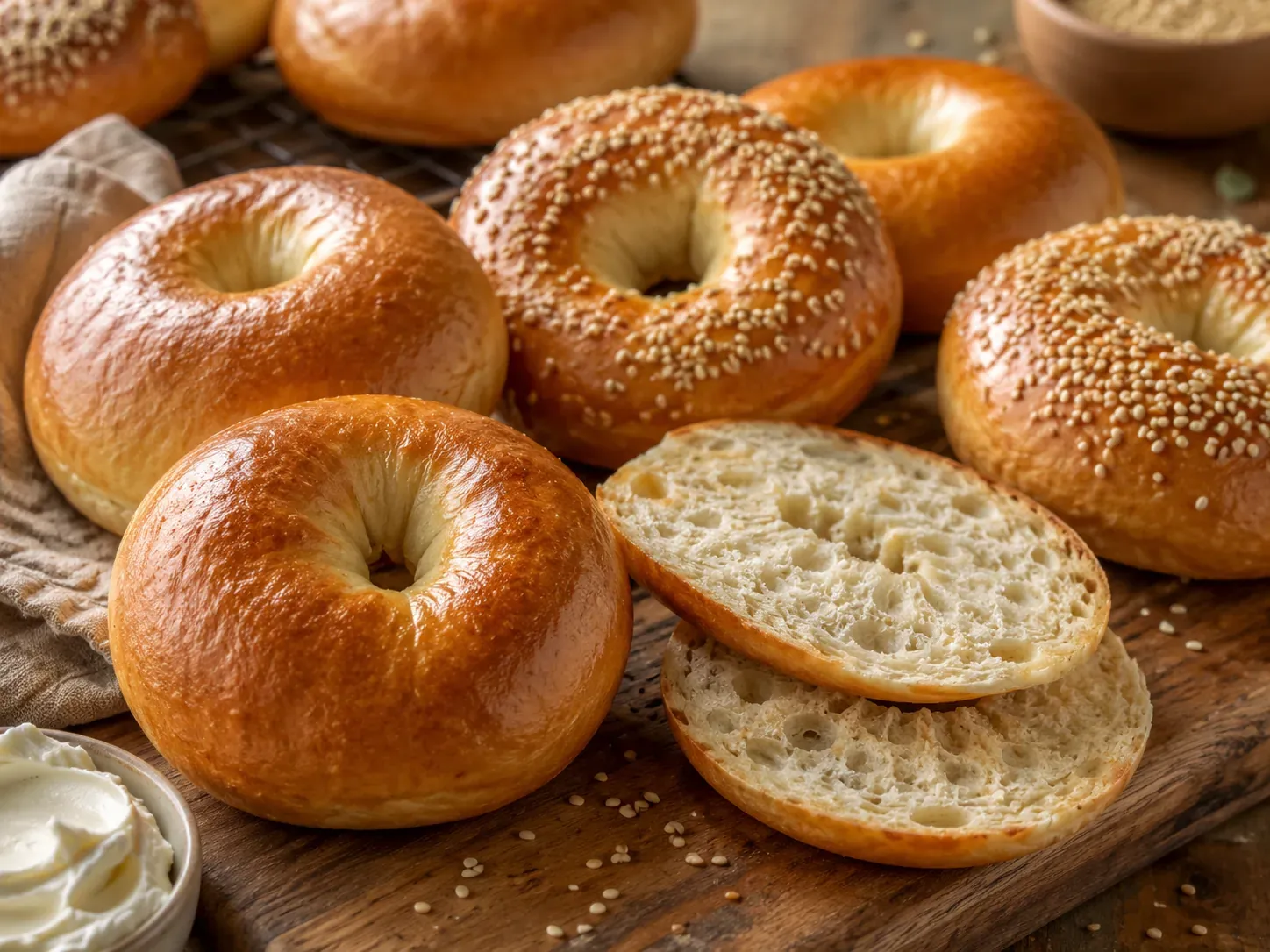
Chewy homemade bagels with glossy golden crusts and soft, dense centers.
- Measurements grams + cups
Why You'll Like This Recipe
- The boiling step is what makes a bagel a bagel — it sets the crust before the oven does, and it takes about a minute per batch.
- No special equipment beyond a wide pot and a slotted spoon.
- Plain, sesame, everything or salt from the same dough.
Chewy homemade bagels with glossy golden crusts and soft, dense centers.
Recipe
Classic Homemade Bagels
Chewy homemade bagels with glossy golden crusts and soft, dense centers.
Ingredients
Ingredients scaled. The method below still refers to the original quantities.
Instructions
- Step 1. Combine the warm water, sugar, and yeast. Add the bread flour and salt and mix into a stiff dough.
- Step 2. Knead 8 to 10 minutes until smooth and elastic. Cover and let rise 60 minutes.
- Step 3. Divide into 8 equal pieces. Shape each into a tight ball, poke a hole through the centre, and stretch into a bagel shape.
- Step 4. Rest the shaped bagels 15 to 20 minutes while heating the oven to 220 C / 425 F.
- Step 5. Bring a wide pot of water to a gentle boil and add the honey or brown sugar.
- Step 6. Boil the bagels 30 seconds per side, then transfer to a parchment-lined baking sheet.
- Step 7. Brush with egg wash if using and add toppings.
- Step 8. Bake 20 to 24 minutes, until deeply golden. Cool at least 15 minutes before slicing.
Notes
- Bread flour gives bagels their best chew. Keep the dough fairly firm rather than soft or sticky.
- The dough should feel noticeably firmer and drier than a bread dough. That stiffness is correct — a soft, slack dough will not hold a bagel shape through boiling.
- Boil in batches of two or three. Crowding the pot drops the water temperature and the bagels come out pale.
Classic Homemade Bagels — Simple Table Recipes · https://simpletablerecipes.com/recipes/classic-homemade-bagels/
Ingredient Notes
- Bread flour
- Bread flour is doing real work here. Its higher protein is what produces the dense, chewy interior a bagel is supposed to have. All-purpose flour will bake into something closer to a bread roll with a hole in it.
- Honey in the boiling water
- The honey or brown sugar in the water is for the crust, not the flavour. It helps the surface gelatinise and brown, which is where the glossy sheen comes from.
Equipment
- Wide pot for boiling
- Slotted spoon
- Baking sheet
- Parchment paper
- Kitchen scale
Substitutions
- Honey
- Brown sugar in the same quantity works identically in the boiling water. Barley malt syrup is the traditional choice and gives a slightly deeper colour if you have it.
- Toppings
- Sesame seeds, poppy seeds, everything seasoning or coarse salt all go on straight after boiling, while the surface is still wet enough to hold them.
Storage & Freezing
Storing: Keep in a paper bag at room temperature for 2 days. Plastic traps moisture and softens the crust, which is the opposite of what you want.
Freezing: Slice before freezing, then toast straight from frozen. Freezing them whole means waiting for a thaw before you can cut them.
Frequently Asked Questions
Why do you have to boil bagels?
Boiling gelatinises the starch on the outside of the dough before it goes into the oven. That sets the crust, limits how much the bagel can rise, and produces the dense chew and glossy skin. A bagel baked without boiling is just a roll shaped like a bagel.
How long should I boil bagels for?
30 seconds per side is right for this recipe. Longer gives a thicker, chewier crust and a slightly wrinkled surface. Much beyond a minute per side and the crust turns tough.
Can I make bagels without bread flour?
You can, but the texture changes noticeably. All-purpose flour has less protein, so the crumb comes out softer and more open — closer to a bread roll. If bread flour is what you are after in a bagel, it is the one ingredient worth buying specifically.
Why did my bagels come out flat?
Usually a dough that was too soft, or bagels left to over-rise before boiling. The dough for bagels should be stiff, and the shaped rings only need 15 to 20 minutes rest — they are not meant to double.
How do I shape a bagel?
Roll each piece into a tight ball, then push your thumb through the centre and stretch the hole to about 4 cm. Make the hole larger than looks right — it closes up considerably during boiling and baking.
Do I need an egg wash?
No. Egg wash gives a deeper shine and helps toppings stick, but bagels boiled with honey in the water already brown well. Skip it if you would rather not, and add toppings straight after boiling while the surface is wet.
Did you make this?
Let other people know how it went. One tap, nothing to fill in.
Thanks — that helps.