Easy French Baguettes
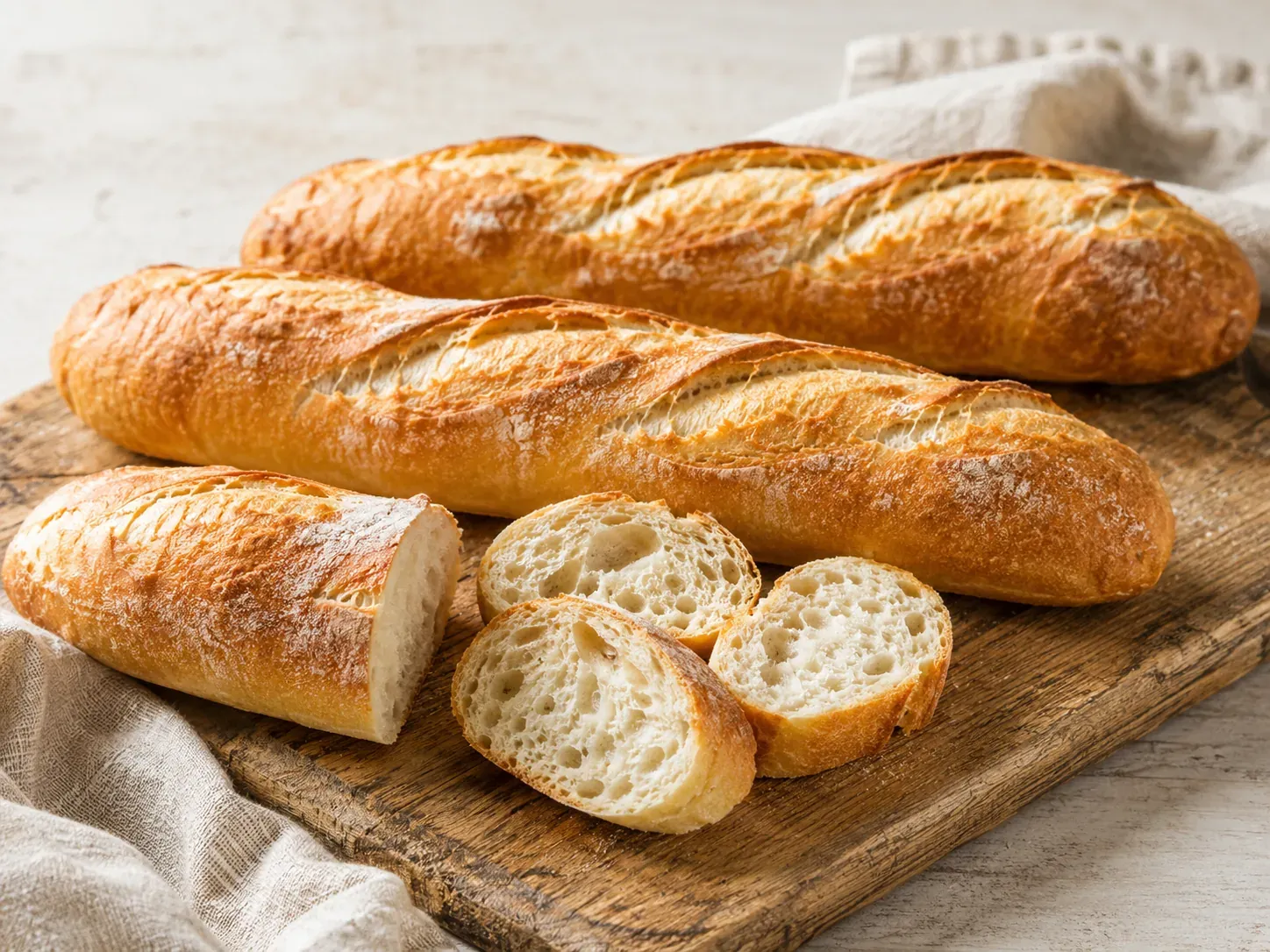
Two crisp, golden baguettes with chewy interiors and a simple everyday dough.
- Measurements grams + cups
Why You'll Like This Recipe
- Four ingredients — flour, water, yeast and salt.
- The steam trick turns a domestic oven into something much closer to a bakery one.
- Two baguettes, best eaten the day they are made.
Two crisp, golden baguettes with chewy interiors and a simple everyday dough.
Recipe
Easy French Baguettes
Two crisp, golden baguettes with chewy interiors and a simple everyday dough.
Ingredients
Ingredients scaled. The method below still refers to the original quantities.
Instructions
- Step 1. Mix the flour, water, yeast, salt, and sugar until no dry flour remains.
- Step 2. Knead 6 to 8 minutes until smooth, or use three stretch-and-fold rounds at 20-minute intervals.
- Step 3. Cover and rise 75 to 90 minutes, until doubled.
- Step 4. Divide into 2 pieces and gently pre-shape into short logs. Rest 15 minutes.
- Step 5. Shape each into a baguette about 35 to 40 cm / 14 to 16 inches long.
- Step 6. Place on parchment or a floured couche. Cover and proof 30 to 40 minutes.
- Step 7. Heat the oven to 245 C / 475 F with a baking stone or heavy sheet inside. Score each baguette 3 to 4 times.
- Step 8. Bake with steam for 22 to 27 minutes, until deep golden and crisp.
Notes
- For steam, place a preheated metal pan on the lower rack and carefully add a cup of hot water when the baguettes go in.
- Adding water to a hot pan produces a burst of steam. Stand back, and use the pan you mind least about warping.
- The pre-shape and 15-minute rest are worth doing. They let the gluten relax so the final shaping does not fight you.
- Score decisively at a shallow angle — about 30 degrees to the surface, not straight down. Timid scoring closes up in the oven.
- Get the steam in fast and shut the door. Most of the benefit is in the first few minutes.
Easy French Baguettes — Simple Table Recipes · https://simpletablerecipes.com/recipes/easy-french-baguettes/
Ingredient Notes
- Bread flour
- Baguette dough is wet and needs strength to hold its shape through shaping and proofing. All-purpose flour gives a flatter, softer loaf.
- Water at 70 percent
- A wet dough. That hydration is what produces the open crumb and the crackling crust, and it is why the dough feels harder to handle than a sandwich loaf.
Equipment
- Baking stone or heavy baking sheet
- Metal pan for steam
- Lame or sharp blade
Substitutions
- Baking stone
- A heavy preheated baking sheet works nearly as well. Preheat it empty for at least 30 minutes.
- Couche
- A floured tea towel pleated between the loaves does the same job of holding their shape while they proof.
- Sugar
- Optional. It speeds the rise slightly. A traditional baguette has none.
Storage & Freezing
Storing: Baguettes are best within hours of baking. Revive a day-old one in a hot oven for 5 minutes.
Freezing: Freeze whole for up to 3 months and refresh from frozen at 180 C / 350 F for about 15 minutes.
Frequently Asked Questions
How do you get a crispy crust on baguettes?
Steam in the first few minutes. Preheat a metal pan on a lower rack and pour in a cup of hot water as the bread goes in. The steam keeps the surface soft long enough to expand, then sets into a thin crackling crust.
Why did my baguette scores not open?
Usually scored too shallow, too vertical, or too late. Cut at about a 30 degree angle to the surface, roughly 1 cm deep, immediately before the loaf goes in.
Can I make baguettes without a baking stone?
Yes. A heavy baking sheet preheated for 30 minutes gets you most of the way. The important thing is that the surface is already hot when the dough hits it.
Why are my baguettes flat?
Over-proofed, or shaped too loosely. Baguettes need surface tension to hold their shape. Proof 30 to 40 minutes only — they should look puffy, not doubled.
Is bread flour necessary?
It makes a real difference here. This is a wet dough, and bread flour has the protein to hold it together. All-purpose gives a flatter, softer baguette.
Did you make this?
Let other people know how it went. One tap, nothing to fill in.
Thanks — that helps.