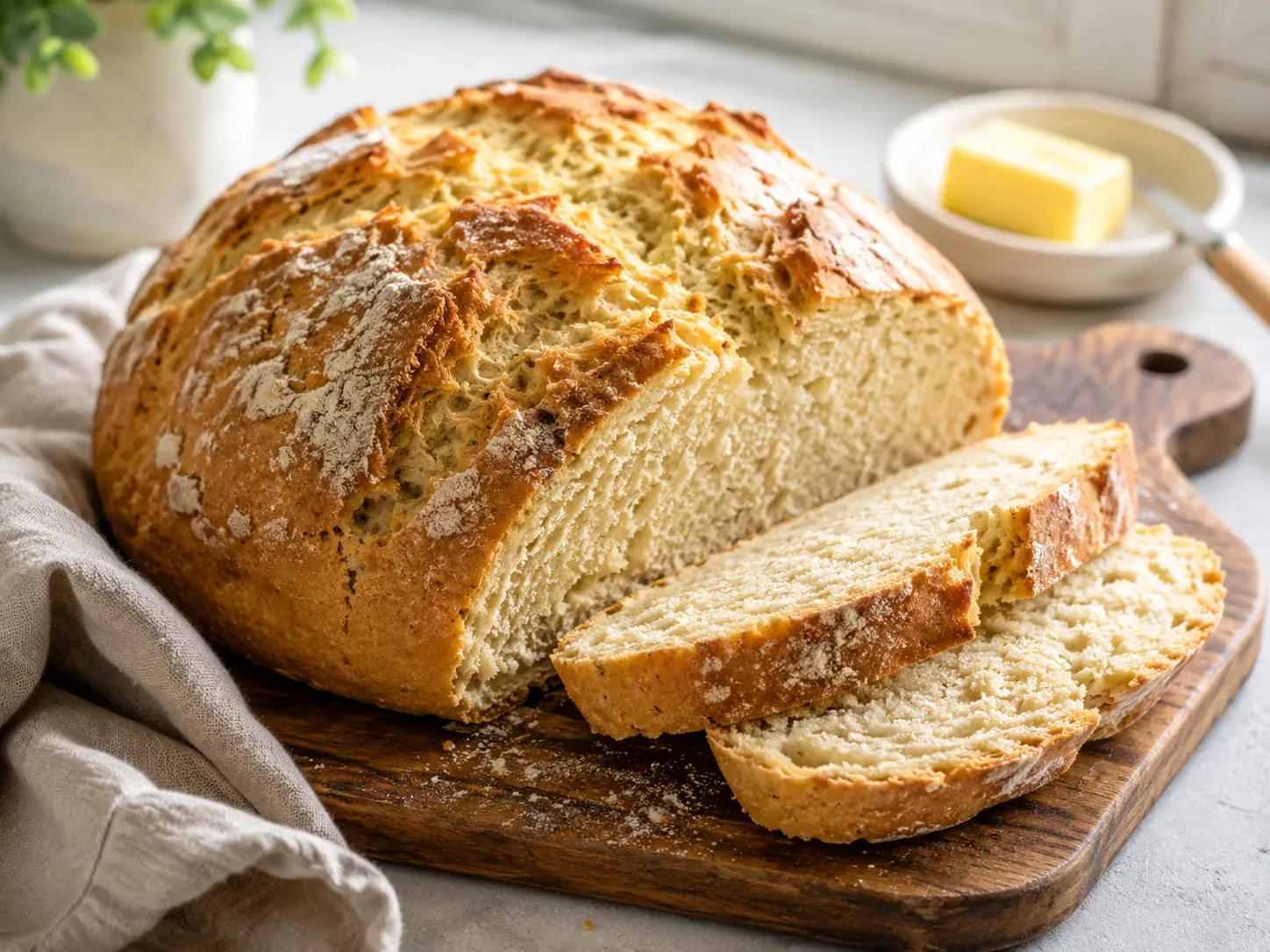
No-Knead Dutch Oven Bread
A crusty artisan-style round loaf with an open crumb and almost no hands-on work.
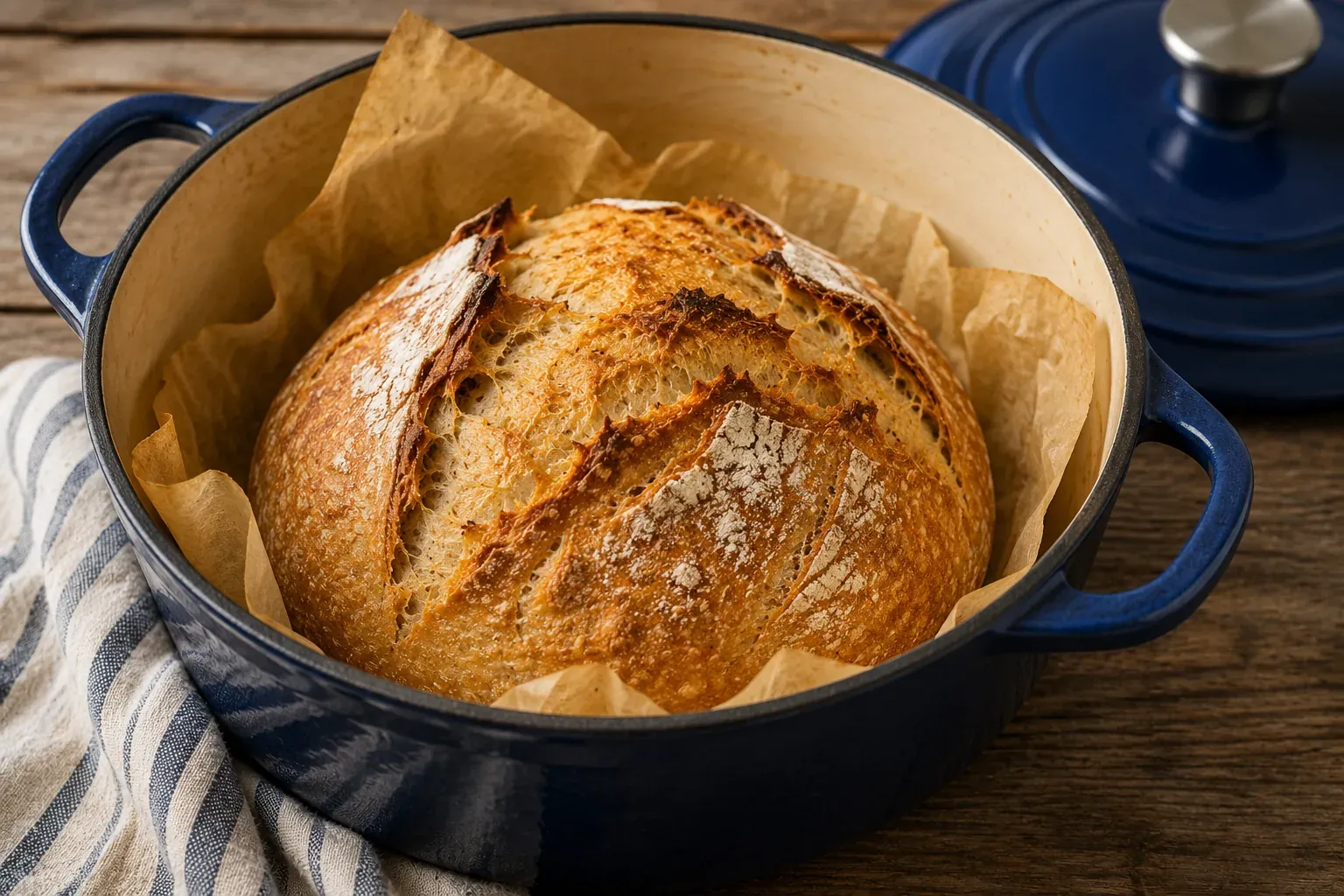
- Measurements grams + cups
Why You'll Like This Recipe
- Four ingredients, no kneading, and about ten minutes of actual work.
- The overnight rise does what kneading would — you are trading effort for time.
- A Dutch oven traps steam, which is how you get a bakery crust in a home oven.
A crusty artisan-style round loaf with an open crumb and almost no hands-on work.
Recipe
No-Knead Dutch Oven Bread
A crusty artisan-style round loaf with an open crumb and almost no hands-on work.
Ingredients
Ingredients scaled. The method below still refers to the original quantities.
Instructions
- Step 1. Stir the flour, salt, and yeast together in a large bowl.
- Step 2. Add the water and stir until no dry flour remains. The dough will be sticky.
- Step 3. Cover and leave at room temperature 12 to 18 hours.
- Step 4. Turn the dough onto a floured surface and gently shape into a round.
- Step 5. Rest 30 minutes while a covered Dutch oven heats in a 230 C / 450 F oven.
- Step 6. Carefully transfer the dough to parchment and lower it into the hot Dutch oven.
- Step 7. Bake covered 30 minutes.
- Step 8. Remove the lid and bake another 12 to 15 minutes, until deeply browned. Cool fully before slicing.
Notes
- The quarter teaspoon of yeast is correct. The long overnight rise does the work that kneading and extra yeast would otherwise do.
- The listed time is almost entirely unattended. Hands-on work is about ten minutes.
- The Dutch oven must be preheated with its lid on. Trapped steam from the dough is what gives the crust its blistering, and a cold pot will not produce it.
- The dough will look shaggy and wet after mixing and slack and bubbly the next morning. Both are right.
- Preheat the Dutch oven empty, with the lid on, for at least 30 minutes. A cold pot produces no steam and no crust.
No-Knead Dutch Oven Bread — Simple Table Recipes · https://simpletablerecipes.com/recipes/no-knead-dutch-oven-bread/
Ingredient Notes
- Instant yeast
- A quarter teaspoon is correct and not a typo. A tiny amount of yeast fermenting for 12 to 18 hours develops far more flavour than a full spoonful working for an hour.
Equipment
- Dutch oven with a lid
- Large bowl
- Parchment paper
Substitutions
- Dutch oven
- Any heavy lidded pot that is oven-safe to 230 C / 450 F works — cast iron, enamelled cast iron, or a deep casserole with a lid. The lid matters more than the material.
- Bread flour
- All-purpose flour works and gives a slightly softer crumb. Bread flour gives a chewier interior and a little more rise.
Storage & Freezing
Storing: Keep cut-side down on a board for 2 to 3 days. Do not use a plastic bag — it softens the crust within hours.
Freezing: Freeze whole or sliced for up to 3 months. A whole loaf can be refreshed from frozen in a 180 C / 350 F oven for about 20 minutes.
Frequently Asked Questions
How long should no-knead bread rise?
12 to 18 hours at room temperature. The wide window is deliberate — a warm kitchen ferments faster, a cool one slower. The dough is ready when the surface is covered in bubbles and it has spread and slackened.
Can I make no-knead bread without a Dutch oven?
You can, but the crust suffers. The lidded pot traps the dough own steam for the first half of the bake, which is what makes the crust crackle. Without one, bake on a preheated tray with a pan of hot water on the rack below — better than nothing, though not the same.
Why is my no-knead dough so wet and sticky?
Because it is meant to be. At roughly 75 percent hydration this dough is far wetter than a kneaded one, and that water is what develops the open crumb without any kneading. Handle it with floured hands and shape it loosely.
Can I let it rise longer than 18 hours?
It will keep going, but past about 20 hours the flavour turns noticeably sour and the gluten starts to break down, giving a flatter loaf. If you need more time, move the bowl to the fridge and bring it back to room temperature before shaping.
Why did my loaf come out flat?
Usually an over-fermented dough or a shaping stage that was too loose. Shape it into a round with some surface tension, rest it seam-side down, and get it into a fully preheated pot promptly.
Do I need to knead this dough at all?
No. Time does the work. Over 12 to 18 hours the gluten develops on its own through slow fermentation, which is why the recipe uses so little yeast and so much water.
Did you make this?
Let other people know how it went. One tap, nothing to fill in.
Thanks — that helps.